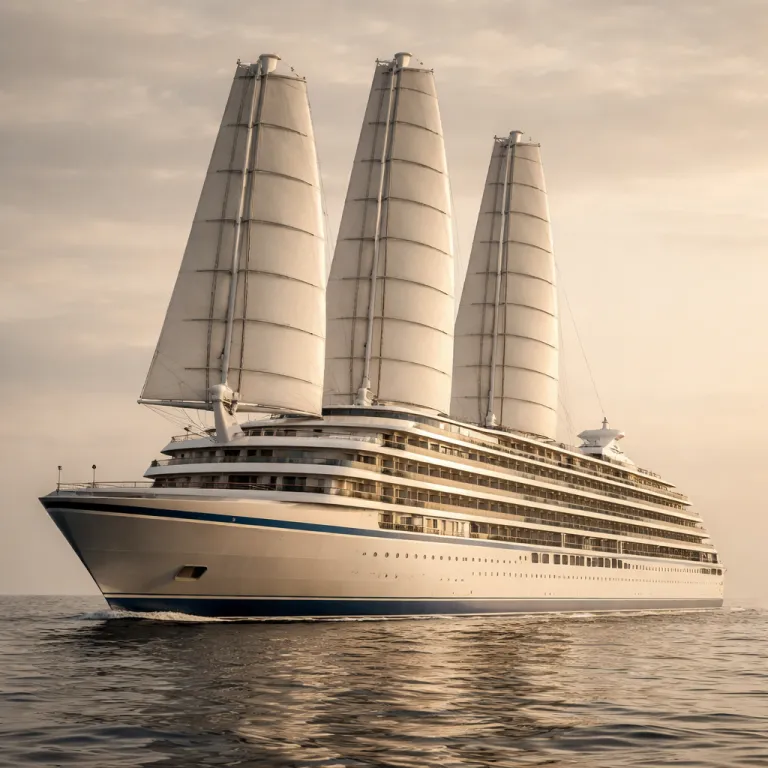
Orient Express Corinthian review: a 108 guest sailing yacht built around wind
The Orient Express Corinthian story begins on the quay at Saint-Nazaire, where the new sailing yacht slipped quietly away from the Chantiers de l’Atlantique yard under its three vast SolidSail rigs. This Corinthian project is not a theoretical exercise in greenwashing; it is a 220-metre sailing ship designed from the keel up to cruise at around 12 knots on wind alone, with hybrid LNG engines as backup rather than the main event. For couples used to conventional cruise ship experiences, that single fact shapes every moment of the voyage, from the way the vessel heels gently under sail to the way sea views remain blissfully free of funnel smoke.
At the heart of this review sits SolidSail, a rigid carbon-fibre sail system mounted on three tiltable masts that rotate 360 degrees to chase the wind. According to Chantiers de l’Atlantique’s published specifications for its SolidSail–AeolDrive concept, the rig can carry roughly 4,500 square metres of composite panels, which means the crew can run long stretches of wind-assisted cruising without burning fuel, and the captain can trim the yacht with the precision of a racing team while guests linger over a French apéritif. When the masts tilt to pass under 70‑metre bridges on Adriatic cruises, the spectacle on deck becomes part engineering theatre, part Art Deco performance staged against the sea.
For a luxury cruise audience, the question is simple yet radical: will this Orient Express gamble on wind propulsion change how the industry thinks about small ships? The answer, based on this early sailing, is yes, because the Corinthian feels like a true sailing yacht first and a cruise ship second, with the AeolDrive articulated mast system and SolidSail technology working almost silently beneath the polished teak deck. Yard engineers describe SolidSail as a “rigid sail system for primary wind propulsion with LNG engines in hybrid support,” and that low-key definition understates how different the experience feels once you are actually under way.
Design, suites and sea views: Orient Express DNA translated to a ship
Any serious look at the Orient Express Corinthian has to go beyond propulsion and into the suites, because this is where Accor and the Orient Express brand stake their luxury credentials. The 54-suite layout keeps the guest count to just 108 passengers, which means couples can treat the ship more like an intimate yacht than a floating resort, and every cabin feels close to the sea rather than buried deep inside a hull. Maxime d’Angeac, the French architect behind the interiors, leans into Art Deco references from the original express train, but softens them with curved wood, lacquer and textiles that feel more Côte d’Azur than nostalgia museum.
On this cruise the most coveted suites are the corner units with wraparound sea views, where sliding doors open directly onto private terraces that sit almost flush with the deck. Inside, the palette nods to France without cliché; think cream panelling, deep blue fabrics and brass detailing that recalls historic Orient Express carriages while remaining resolutely contemporary. Couples moving between suite and public spaces pass Guerlain spa cabins, a Yannick Alléno restaurant and a 115-seat cabaret lounge, each space scaled to the ship’s modest size so the luxury feels concentrated rather than diluted across multiple decks.
For readers used to land stays with names like Ritz-Carlton or high-end yacht charters, the key comparison is intimacy rather than bling, and this is where the Corinthian becomes especially relevant for hotel loyalists. The ship’s lap pool, small but beautifully framed by teak and glass, feels closer to a private villa pool than a resort water park, and the surrounding deck furniture is spaced for couples rather than crowds. If you have ever questioned whether a big hotel brand at sea guarantees seamanship, the analysis in this guide to hotel brands at sea offers useful context before you book this particular cruise.
Routes, industry impact and what this means for future luxury cruises
The maiden cruise from Saint-Nazaire to Lisbon signals how the Orient Express team intends to use this ship; itineraries will hug coastlines where wind and scenery both matter, from Cassis and Saint-Tropez to Monte Carlo, Venice and Rovinj. On these routes the captain can prioritise sail over engine, letting the yacht glide into anchorages where tenders shuttle guests ashore because the harbour is too beautiful to dock, and the absence of constant engine vibration becomes part of the onboard narrative. For couples who usually book design-forward hotels, this feels less like a standard cruise and more like a moving coastal retreat that happens to change address every night.
From an industry perspective, the wind-powered cruising concept backed by Accor and built by Chantiers de l’Atlantique is a clear statement that wind-assisted luxury voyages are moving from prototype to product. The partnership with LVMH on the wider Orient Express yacht collection, and the sister ship Olympian already under construction, suggests that this will not remain a one-off yacht but the start of a small fleet, and that matters for emissions as well as aesthetics. Chantiers de l’Atlantique has indicated that SolidSail–AeolDrive can cut propulsion-related CO₂ emissions by around 40 percent on suitable routes, and the ability to maintain close to 12 knots under sail alone on a 220‑metre ship sets a benchmark that other cruise lines, from expedition specialists to Ritz-Carlton style players, will struggle to ignore.
For travellers comparing future cruises, the practical takeaway is to look beyond the brochure language of luxury and ask how much of your journey will actually be under sail, how many suites share each deck and how the ship’s design frames the sea views you are paying for. Reading technical coverage from Cruise Industry News or commentary from writers such as Sue Bryant can help decode the engineering claims, while design-focused pieces like this feature on curated yacht escapes show how serious operators think about yacht-style Corinthian experiences. If you enjoy the romance of an express train and the craftsmanship of a scale model, you may also appreciate how a carefully chosen Viking ship model on your desk can keep the idea of a future sailing yacht adventure firmly in view between trips.